
The other Michelangelo…
Valetta, Malta Day 2
Day 7/16 Viking Vesta, Malta, Morocco and the Mediterranean
March 19, 2026
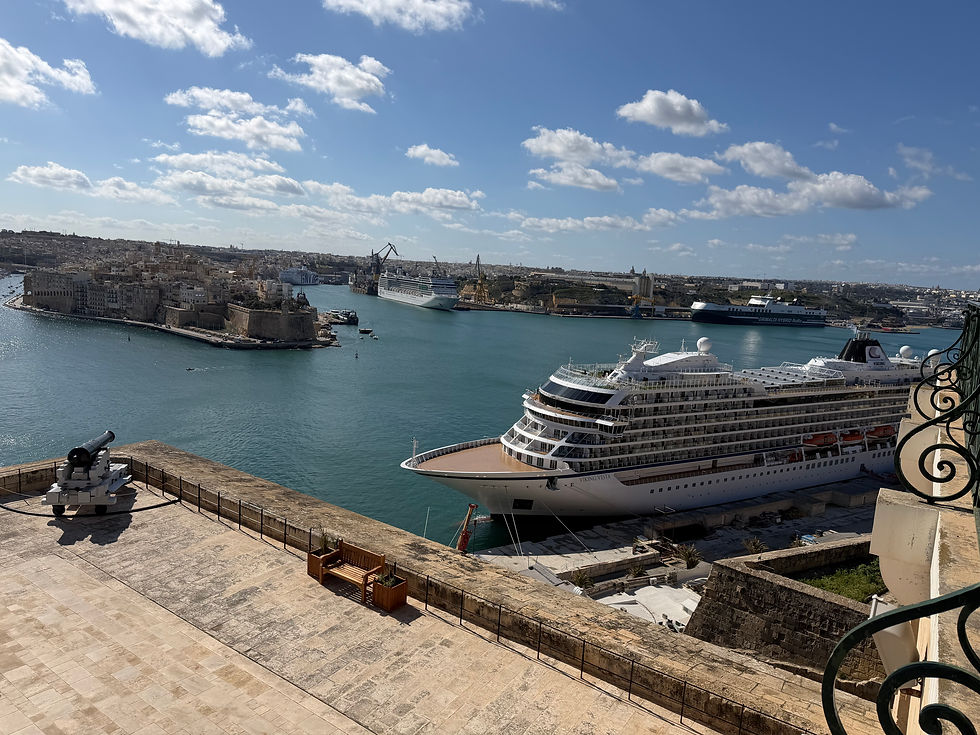
Viking Vesta docked in Valetta, Malta
Today our back on board time was 3pm. Since we had docked overnight in Valetta, we had another partial day to explore this magical place! It was also nice to know we didn’t have to wake up with an alarm clock for a tour and that we had about a half day to ourselves to explore at leisure, now that we knew our way around Valetta. There is a comfort level that comes from having 2 back to back days in port that makes it an easier touring experience.
When we exited the Vesta we saw the Viking tour guides were lined up outside the buses that our fellow cruisers were using to take their optional tours today, but we marched on by knowing that we would be fine on our own to explore more of Valetta without the need for an optional tour.
We paid our 1 euro each for the return ride on the lift at the Lower Barakka Gardens which took us up to downtown Valetta and started wandering the nearly empty streets. At 9:30am Valetta was pretty deserted because today was a holdiay in Malta - The Feast of St. Joseph (March 19th).
As we wandered down a few streets in Valetta we had never been on before we heard the most glorious angelic singing being piped through speakers on the street we were on. The voices from the choir were so angelic that I had to stop to video tape the music. It was so very magical to be walking through this ancient city that was founded in 1565 by the Knights of St. John, on a public holiday.

Valetta is the Southern most capital of Europe and at .61 sq km or .24 sq miles, is also the smallest capital city. The 16th century buildings were constructed by the Knights Hospitaller and most of the city is Baroque in character. During WWII Valetta and the surrounding 3 cities were the most heavily bombed place in the entire war. The island endured over 3,000 air raids and sustained 154 consecutive days and nights of bombing in 1942- receiving more bombs in one month than during the entire Blitz on Britain. 6,700 tons of bombs were dropped on the island during the war. Since Malta was a British colony and because of Malta’s strategic location in the Mediterrean (close to Italy) the naval forces of Italy and Germany heavily bombed the Royal Air Force and British Royal Navy which were docked in Malta.
In 1980 UNESCO declared the city of Valetta a World Heritage site. The city has 320 monuments making it one of the most concentrated historic areas in the world. Sometimes Valetta is called an “open-air museum” and in 2018 Valetta was chosen as the European Capital of Culture. Valetta is also listed as one of the sunniest cities in Europe. Today was a beautiful 17C or 63F, sunny day! A great day for exploring this beautiful walled, port city.
As we continued to wander the streets of Valetta I mentioned to Richard that I wanted to visit St. John’s Co-Cathedral which we had seen pictures of in the port talk. We referenced our handy map that we had picked up at the Valetta Visitors Centre outside of the Cruise Terminal and saw that we were right around the corner from the Cathedral. I had tried to purchase tickets on-line last evening for a visit to St. John’s but all of the tickets appeared to be sold out.
As I walked up to the ticket office there was no one in line in front of me and I asked if we could purchase tickets. The cashier asked if we were adults or seniors over 60, so we were able to purchase our tickets at a discount for 12 euros each and headed into the Cathedral.

St. John’s Co-Cathedral is a baroque masterpiece and as I walked into the Cathedral I was simply astounded at how gorgeous the cathedral was.
I have never seen anything like this cathedral anywhere in the world.

The floors of the cathedral are the most beautiful I have ever seen, as the entire floor of the cathedral is covered with marble tombstones. The 378 tombstones commemorate some of the most illustrious knights of the Order. The Latin epitaphs on the tombstones describe the virtues of each individual knight buried below the stone.

Many of the tombstones have the symbol of death - the skeleton with a sickle or an hourglass signifying the passing of time. Crowns and coronets indicate the most noble of the knights. Many tombstones have arboreal shields and weapons ranging from battle flags to helmets etc. All of the tombstones are composed of coloured inlaid marble and they date from the early seventeenth centurey to the late eighteenth century.

The tombstones were not part of the original design of the church when it was inaugurated in 1577. The church was a very simple, bare church when it was built. The Knights that fell during the 1565 Great Siege of Malta were originally buried in Fort St Angelo but were later re-interred in the St. John’s cemetery.

In 1606 some 25 years after the church was opened is the first record of a person being buried in St. John’s. The baroque tombstones are full of movement and there is eloquent symbolic language on the stones. Only Knights Grand Cross or at least those who had achieved specific honours in battles involving the Order were buried in the church. The positioning of the tombstones was similarly strictly hierarchical. Higher up Knights of the Order face the high altar. The floor of St. John’s has sometimes been called a roll call of the noble families of Europe before the French Revolution. The inscriptions on each tombstone record the achievements of the deceased sometimes in humorous terms along with a pleas for prayers for his soul.
The Order commissioned known artisans to cover the vaults with marble monuments. There are known to be at least two main sculptors of the tombstones. Vitale Covati a sculptor from Messina who came to Malta in 1645 and worked at St. John’s for 28 years. Bartholomeo Bambace is another sculptor from Palermo who worked with Vitale.
The marble used in St. John’s came from a number of countries and places. Red marble came from Messina, Sicily. Black marble from Belgium. Yellow from Siena, Italy and some other red marble came from France. More colours of marble came from Africa and Spain and the white marble came from Carrara.

We were amazed that we were allowed to walk on the tombstones as there are millions of people who walk over these tombstones in a year. The tombstones are constantly being restored and stiletto heels are strictly prohibited in the Cathedral!
The Cathedral itself is a wonder of Baroque architecture in Europe and one of the worlds great cathedrals. The Knights who were responsible for decorating the Cathedral to its glory came to Malta in 1530 after they were evicted from their earlier home in Rhodes by the Turks in 1522. Ottoman Sultan Suleiman the Magnificent sent 40,000 men to besiege Malta and the Turks were unable to siege the island. After defending Malta from the Ottomans the Knights turned Malta into a fortress that befitted a military Order and built a new capital city in Valetta worthy of noblemen.
The Italian artist Michelangelo Merisi, better known as Caravaggio was born in 1571. Orphaned at 11 years old, he lived a troubled life in Rome and during one of his many brawls, killed a man named Ranuccio Tomassoni. The Roman authorities reacted swiftly by issuing a ‘nacho capitale’ on his head. Fearing for his life Caravaggio fled to Naples and eventually Malta. Since Malta was the headquarters of the Knights of the Order of St. John, Caravaggio was soon accepted into the folds of the Order and in 1608 he became a Knight of Obedience. The Grand Master at the time knew of Caravaggios past, which should have impeded him from entering the Order. Yet the Grand Master obtained papal permission to accept Caravaggio as a Knight.

While in Malta, Caravaggio was commissioned by the Order to paint “The Beheading of St. John the Baptist”, in 1608, which was to be an altarpiece. The painting, which some consider “one of the most important works in Western painting” and one of the ten greatest works of all time, is preserved in the Oratory in St. John’s Co-Cathedral. “Death and human cruelty are laid bare by this masterpiece, as its scale and shadow daunt and possess the mind.”
The painting is 12 feet by 17 feet and the prominent colours are the red and warm yellow colours common in the Baroque period. The painting is the only work by Caravaggio to bear the artist’s signature, which he placed in red blood spilling from John the Baptist’s cut throat. The figures look life sized because of the size of the painting.

Caravaggio’s calm period in his life was short-lived and by late August 1608 he was in trouble again for a brawl where a number of knights were wounded. Caravaggio was arrested and imprisoned in Fort St Angelo Malta. Instead of waiting for his trial, he escaped and fled from Malta. Caravaggio died under sketchy circumstances and some chairman he died of lead poisoning from having used high amounts of lead in his paints. They claimed he died because of sepsis of a wound sustained during a brawl in Naples. Regardless of how he died, he definitely had a controversial life and painted some very important masterpieces of the Baroque period.
After spending about 45 minutes inside wandering around the glorious Cathedral (and finding the free washrooms off to one side of the Cathedral) we noticed that by now 2 Viking groups were wandering through the Cathedral with guides and the lineup outside the Cathedral was snaked around and around and down to the pedestrian street. We were sure glad that we got to the Cathedral shortly after it opened today. We could have taken audio guides included in our admission for 20 stops around the Cathedral, but we preferred to just wander around, look at the spectacle of the Cathedral and do our own research after we had been to the Cathedral. Sometimes having someone talk in my ear when I want to enjoy the moment, is just not that enjoyable!

Outside the St. John’s Co Cathedral the city of Valetta was now coming alive with artists and vendors who were lining the mostly pedestrian street of Republic Street waiting for all of the locals and tourists to come and visit with each other on this special holiday. I saw a caricature artist who had an empty chair and decided like we had done in Strasbourg, France, I would sit for a caricature. Richard snapped this photo of the artist at work and of course I had no idea how the sketch was turning out. The cost was 15 euros and Richard tipped 5 euros to the artist. He was happy to have some business as I was his first customer of the day!

Colourful doors of Valetta.

The wooden balcony matches the front door of each dwelling.

Very unique brass doorknockers
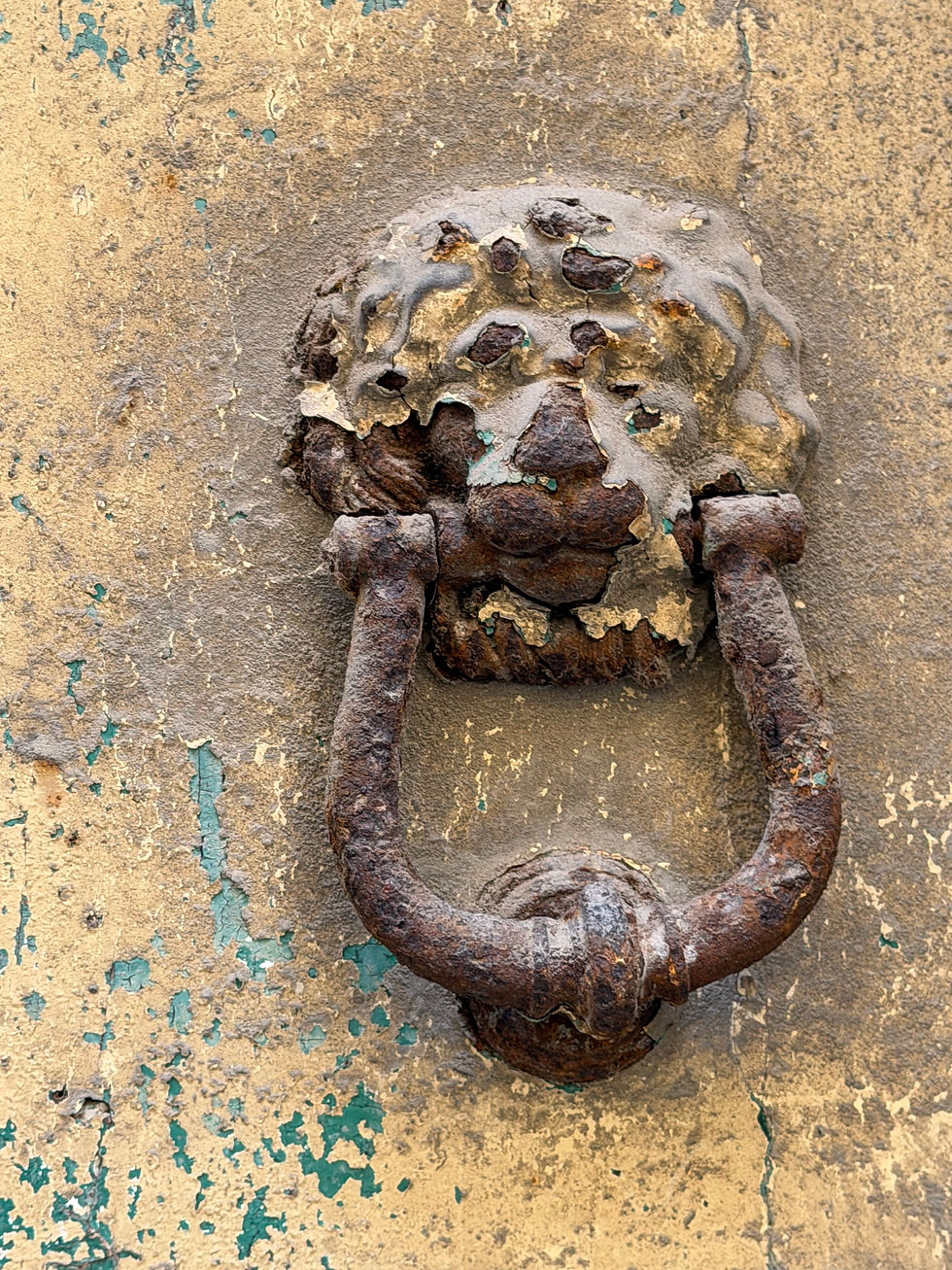
A very old door knocker in Valetta.
We wandered around some more down the alley ways and small streets of Valetta. There are some very pretty doors, door knockers and balconies in the streets of Valetta and it was nice to wander like we were lost and see new sights, without a clear destination in mind on our last day in Valetta.

Being a religious holiday today there were many parades of priests and religious orders wandering through the streets of Valetta. We saw 2 parades go by in the space of 30 minutes and we stopped to watch, listen to the music and enjoy the spectacle.
We noticed that Valetta was getting very busy as another cruise ship had also arrived in port and they were touring with guides and audio devices through the main streets of Valetta. Locals were also starting to congregate in Valetta’s narrow streets with many families taking in the festive holiday atmosphere. We are not ‘crowd’ people so that was our queue to get back to the ship around 1:30pm.

Heading back to the Viking Vesta in Valetta, Malta on our last day in port.

Walking to the Viking Vesta along the pier in Valetta.

Lunch on the Aquavit Terrace on Deck 7 of the Viking Vesta with the Princess cruise ship docked right behind us on Day 2 of our time in Valetta.

The harbour of Valetta. We were due to set sail at 4pm after a back on board time of 3pm, There was to be a scenic commentary by the Resident Historian onboard up in the Explorer’s Lounge on Deck 7/8, but since we are starboard and closer to the aft of the ship, we decided to just watch the sail away from our balcony and skip the commentary.

Passing the lighthouse and breakwall of the Valetta harbour watching the Pilot boat following us on our Starboard side.

Goodbye Valetta and Malta!

The Pilot boat didn’t have far to go. As soon as we went past the breakwall we watched the Pilot board the Pilot boat and they departed for Valetta and we headed out into the open seas of the Mediterranean Sea to Tunisia.
Tonight in the World Cafe on Deck 7 there was ‘Surf and Turf’ with steak and lobster on offer. There was also pre dinner music on the pool deck on Deck 7, followed by live music “Name that Tune” trivia on Deck 7 at 8:15pm.

Julie and I sitting in the Wintergarden on Deck 7 which was opened up to the pool deck for a live “Name that Tune” Trivia. We came close with 24/30 but the winners had 26/30 and it went to a Tie Breaker to determine the winners!
We really enjoyed our two days in Malta and feel like we got to know Valetta a lot better this time around. Our visit to St John’s Co-Cathedral was a highlight of the trip for me and I am so glad we didn’t give up on visiting the cathedral just because I couldn’t purchase tickets online the night before our visit. The marble tombs and the intricacy of the carvings were so beautiful and unique and truly a wonder to behold! While we have seen churches and cathedrals all around the world, this Cathedral is definitely worth a visit if you are ever in Valetta!
And who knew that there was another famous Michelangelo who went by the name of Caravaggio who painted one of the ten greatest works of art of all time? I’m so glad that we had the chance to see his works of art and all for the price of a senior’s admission to the Cathedral!


Comments