
French…for now!
Day 3 Viking Vesta ‘Malta, Morocco and the Med’ Cruise from Barcelona to Barcelona
Ajaccio, Corsica, France. March 15, 2026
Neither one of us has ever visited Corsica before so we were both quite interested to see what the Island was all about We knew that Napoleon Bonaparte was a native of Corsica but little else did we know about this island that houses 360,000 people.

Corsican flag or ‘A Bandera Corsa’ features a black Moor’s head (Testa Mora) with a white bandana on a white field. The flag was adopted in 1980 from the 18th Century symbol of independence, signifying liberation from Genoese rule, when the bandana was moved from the eyes to the forehead. Just a little bit of foreshadowing to how the Corsican’s view themselves before we even got off the Vesta for our tour today.
I don’t think I had ever paid attention before or knew what the Corsican flag was all about. It certainly stands out amongst flags of other countries. The flag represents “Regional autonomy” and “local pride”.
The weather was pretty miserable for our tour this morning with a forecast of rain and 46F or 8C. We had selected the included tour which involved again a ‘panoramic tour of Ajaccio’ which is the capital of Corscia. There were not a lot of tours that even looked interesting on Corsica given how small the island is.
First off lets do a lesson in how to pronounce where we are visiting. Ajaccio is not pronounced the way it looks. I had always said it incorrectly when looking at our cruise itinerary and learned since attending the port talk where the Excursions Manager Leon (who hails from Ajaccio) pronounced Ajaccio the correct way. UH-ZHAK-SEE-OW! That is how to pronounce Ajaccio the capital of Corsica.
Corscia was formed 250 million years ago with the uplift of a granite backbone on the western side of the island and it is the most mountainous island in the Mediterranean. Only 114 miles long and 52 miles wide Corsica has 620 miles of coastline and 200 beaches. The highest peak of the island is 8,878 feet and the island is 2/3rds made up of mountains which form a single chain. Forests make up 20% of the island. We could see snow on the mountain top from our ship as we docked this morning.

Snow on the mountain top in Ajaccio, Corsica.
Corsica is the 4th largest island in the Mediterranean and is located directly north of Sardinia (which is Italian). Only Sicily, Sardinia and Cyprus are larger islands in the Mediterranean. Corsica is actually closer to Tuscany (56 miles/90km) than the Cote d’Azure in France (110 miles/170km).
In 1584 the Republic of Genoa governor ordered all Corsican farmers and landowners to plant 4 trees yearly: a chesnut, olive, ficus and mulberry tree. Many communities owe their origin and richness to the trees that grew after the mandatory orders. Chesnut bread keeps for 2 weeks and so the island was able to sustain itself during difficult times.
From 1942 to 1943, Corsica was occupied by Italian and later German forces to deter Allied landings close to Italy. The islanders endured difficult conditions, such as food shortages, until the Free French fought against the Germans. The U.S. then established a military base on Corsica after the French had liberated Corsica.
. Key exports include granite and marble, tannic acid, cork, cheese, wine, citrus fruit, olive oil, and cigarettes. The Corsican mafia significantly influences the economy.
Port of Ajaccio.

We bundled up with our rain jackets and packed an umbrella for our walk to the bus for our tour with Pierre who hails from the southern most town of Corsica called Bonifacio. The drive between the Ajaccio and Bonifacio takes about 2.5 to 3 hours.
Our tour was meant to be a 3 hour tour of the sights around Ajaccio with our first stop to visit the Napoleon Bonaparte monument.

The Place d’Austerlitz Napoleon Statue is a major monument in Ajaccio, Corsica inaugurated in 1938 to honor the city’s most famous son. The Statue is a replica of the Seurre’s statue of Napoleon that was originally on the Vendome Column in Paris. The monument honours Napoleon’s victories (our guide told us not to look for the name ‘Waterloo’ on the area leading up to the top of the statue as of course Napoleon lost that battle) and achievements.
The achievements Napoleon accomplished in his lifetime are quite amazing and are still in use today:
The Napoleonic Code (Civil Code) which is the foundation of modern civil law in France and has also heavily influenced legal systems in Belgium, Luxembourg, Monaco, Italy, parts of Germany, Lousiana and Quebec, Canada. It established principles of equality before the law, and property rights.
Centralized Administration (Prefects). Napoleon reorganized French local government, dividing the country into departments managed by prefects appointed by the central government. This highly centralized bureaucratic structure still governs France today.
Meritocracy and the Legion of Honor: Napoleon abolished feudal privileges and established that careers should be open to talent rather than birthright. He created the Legion of Honor to reward civil and military merit, which remains the highest deoration in France.
Educational Structure (Lycees and Universities): He established lycees (state-run secondary schools) to create standardized, elite education system, along with the baccalaureat exam, which is still the primary qualification for University entrance in France.
The Bank of France and Currency: he founded the Bank of France in 1800 to stabilize the economy which remains the central Bank of France today.
Infrastructure in Paris and France: Napolon commissioned major infrastructure projects, including building the Arc de Triomphe, the Bourse (stock exchange) and the addition of significant sections of the Louvre. He also created thousands of miles of new roads, canals and bridges that are still in use today.
Metric System Adoption: While the metric system was introduced during the French Revolution, Napoleon enforced the adoption of the metric system across France and its occupied territories, accelerating its use as the Standard in Europe.
European Nationalism and Unification: Napoleon dismantled the Holy Roman Empire and consolidation of German states which eventually led to the unification of Germany and Italy.
Overall, Napoleon was a visionary leader who transformed Europe from a patchwork of feudal traditions into a more modern, organized and secular society, and yet most people just remember Napoleon as the guy who lost at Waterloo and who wore the big 2 cornered bicorne hat!
As an aside, one of Napoleon’s bicorne hats sold for a record $2.1 million euros in 2023 at auction!
Our guide Pierre noticed that we were getting cold and wet standing around listening to him at the Napoleon memorial so he decided to take us to “the end of the world” in Corsica which was by the seaside about 5 minutes outside of Ajaccio. There was a small museum, washrooms and a food truck and a large bus parking lot. Frankly, there wasn’t much to see, although I did get to take a few nice seaside photos.

A great leading line with a crooked fence.

Always love me a good B&W image

In the distance there are 2 lighthouses on the peaks

Hard sand compacted makes a good leading line too!

It was brisk and I should have worn my down jacket under my goretex coat. I was cold! Thank goodness I brought tights and my Blundstones!

The only food truck which sold coffee, hot chocolate and gelato. Today was not the day for gelato but I gladly welcomed a hot chocolate, just to warm my gloved hands up when I got back on the bus! Richard had an espresso and spoke French of course to the proprietor.
After what turned out to be mostly a long washroom break for most people on the tour, we headed the 5 minutes back to Ajaccio where we were supposed to have a walking tour of the town for an hour. Since it was raining some people decided to ditch the tour and take the bus back to the ship. We decided to stick around for a bit and see where Pierre was taking us before ditching the tour.

Cathedral of Our Lady of the Assumption of Ajaccio where Napoleon was baptised on 21 July 1771. According to legend on August 15, 1769 Leticia Bonaparte felt sudden and severe labour pains while in the cathedral for mass. She rushed home to the Bonaparte home, just steps away and gave birth to Napoleon on a first floor sofa before she could reach her bedroom upstairs.
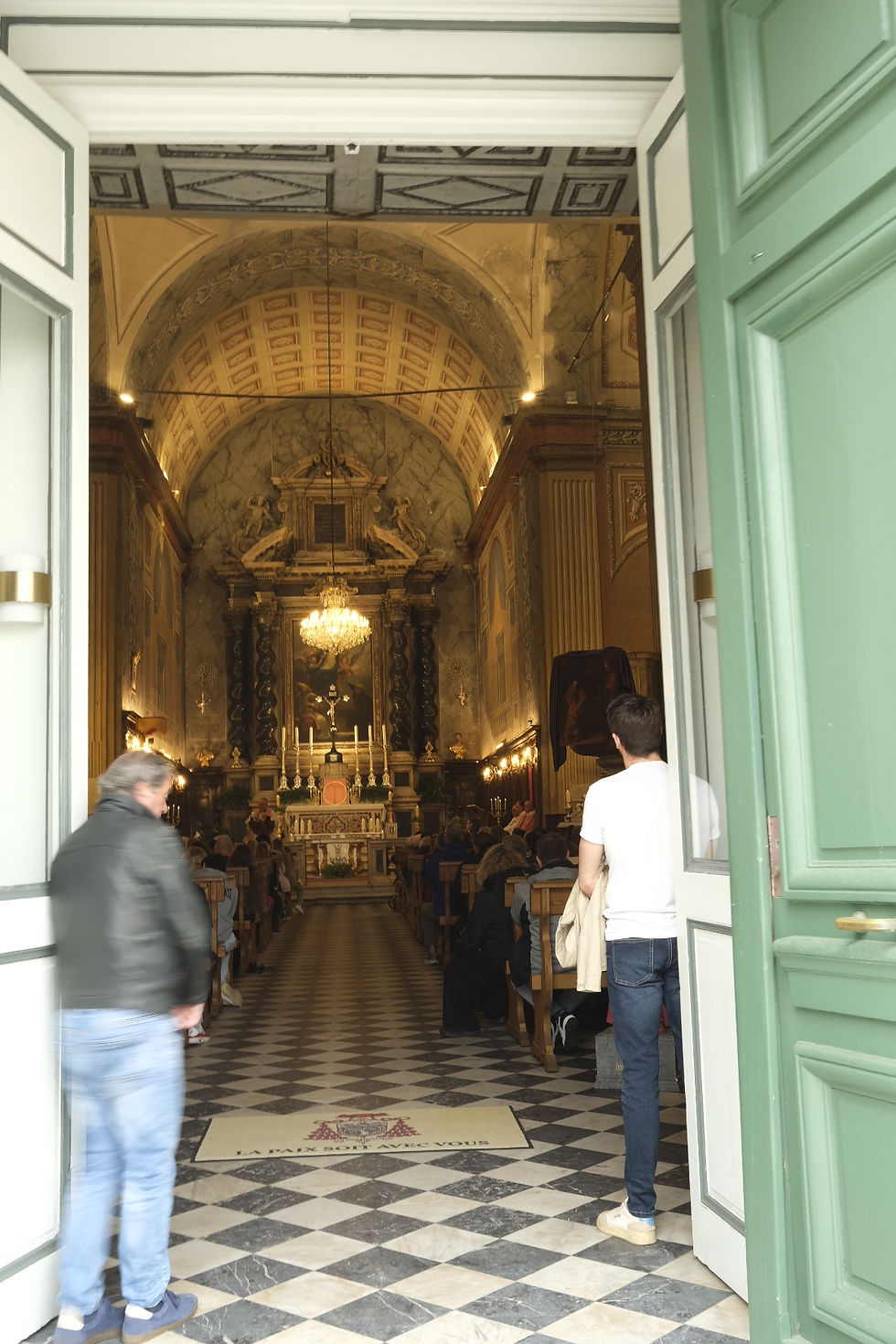
Cathedral of Our Lady of the Assumption of Ajaccio which was open for Sunday Mass.
Pope Francis visited Corsica on December 15, 2024 - the first pope to ever visit Corsica. He visited 4 months before his death and our guide said that the Pope was very good friends with the Cardiinal of Corsica and he wanted to visit Corsica before his death. Pope Francis elevated his friend to Cardinal in 2023.

We then visited The Church of Saint Erasumus which had many different models of boats hanging from the ceiling.


These ship models represent a physical promise kept by sailors. If a sailor survived a shipwreck or a dangerous storm, they would bring a model of their vessel to the church as a sign of gratitude for their survival. Boats hanging from the ceiling symbolize the Christian metaphor of the church as a “ship of salvation”, representing a vessel carrying people safely through the storms of life. Whatever the reason for the hanging ships, it really was a cool church to visit and it was warmer inside than outside too!

We walked in the rain from the ‘ship’ church to the home of Napoleon Bonaparte.
The green building is NOT the home of Napoleon Bonaparte but because the home is right next door to Bonaparte’s home, the owner of the home has turned his mainfloor into a museum to Bonaparte to ‘cash in’ on being lucky enough to live next to Bonaparte’s home.

He even did a sign in the shape of Napoleon’s bicorne hat to make his premises seem more authentic!

Napoleon Bonaparte’s actual family home where he was born.

Gardens opposite Napoleon’s home with orange trees!

Our last stop with our guide Pierre was to another statue of Napoleon. In this statue at Place De Gaulle, Napoleon is dressed in Roman costume meant to emulate the power and authority of Roman emperors, aligning him with the classical, heroic imagery common in 19th C European art. Napoleon is meant to be seen as a fearless leader and lawgiver reinforcing his role as an heir to the Roman Empire rather than just a military leader.
We wandered around Ajaccio for a while and visited their local Monoprix (grocery store) as I wanted to pick up some popcorn, peanut butter and ginger beer.
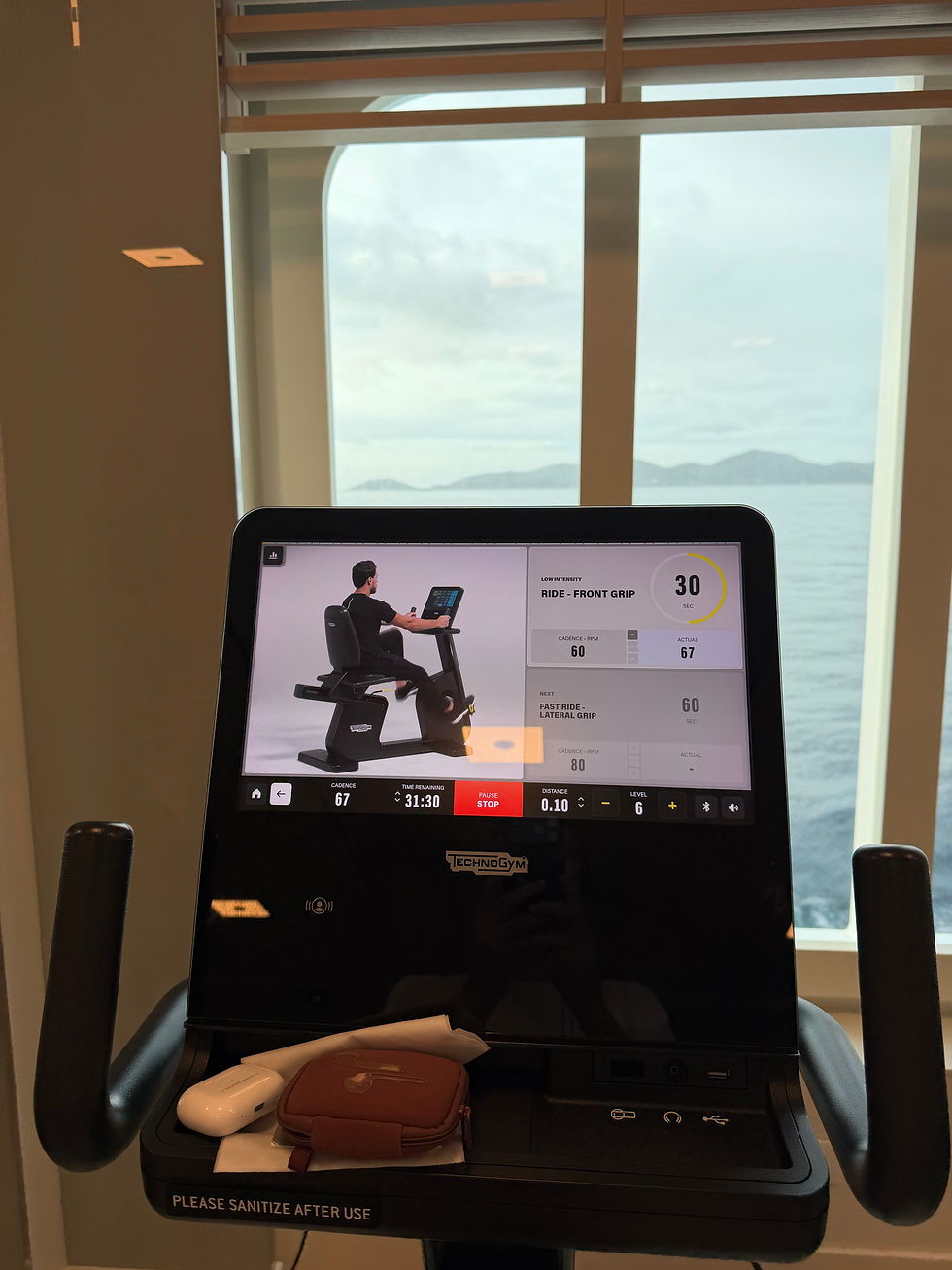
I spent the afternoon in the gym. It was long overdue and I am glad I did! I hope to workout more on the ship and make sure I keep my steps up in addition to the gym!

Leaving Ajaccio at 5pm Sunday evening.
We went up to the World Cafe for dinner as we did not want to have a formal dining experience. We met Dave & Julie who were already in the Cafe and since they had already eaten, they went up and found us a spot to sit in on the 8th deck of the Explorer’s Lounge for Team Musical Name that 60’s Tune Trivia.
We tried out best at Trivia but since we were born in the 50’s and 60’s the music was really not of our generation. 16/30 was our score. Two teams tied at 28/30. We didn’t see the winning members of the team, but we established they must have been older than us to know that much 60’s music as well as the name of the artist who did the music!
Corsica was an interesting port of call and I’m glad we got to visit it. I learned a lot more about Napoleon and seeing his humble birthplace and understanding the impact he had on the world was a really neat experience.
Corsica is hoping for greater autonomy from France, rather than full independence and President Macron of France has offered a form of autonomy to the island, focusing on self-rule rather than separation. Corsicans often prefer doing things their own way due to a strong, distinct cultural identity and a history of independence. Because of their geographic isolation and ties to Italian culture, they emphasize family solidarity, the Corsican language and traditional village norms over mainland French customs. We shall see what happens with Corsica in the years to come but for now they remain under French rule and are an island within the French Republic.


Comments